
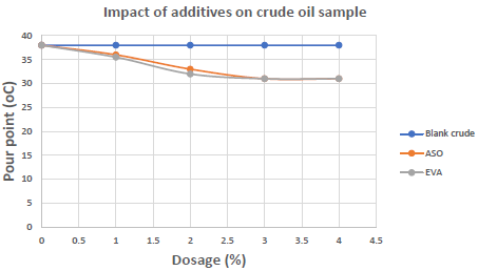
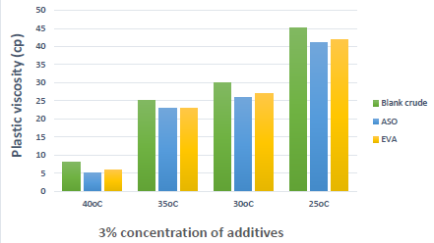
Precipitation and deposition of paraffin wax in subsea pipelines remain a critical flow assurance challenge in the Niger Delta petroleum industry. As crude oil temperatures drop below the Wax Appearance Temperature (WAT) during transport, high-molecular-weight alkanes crystallize to form an interlocking gel network, leading to increased viscosity, pressure drops, and potential pipeline blocking. Conventional remediation using synthetic Pour Point Depressants (PPDs) like Ethylene Vinyl Acetate (EVA) is economically demanding due to importation costs and poses environmental toxicity risks. This study evaluates the technical feasibility of Avocado Seed Oil (ASO), derived from agricultural waste, as an eco-friendly wax inhibitor. Bio-oil was extracted via Soxhlet extraction using n-hexane and characterized using Gas Chromatography (GC). Its rheological performance was tested on a medium waxy crude sample (API: 32.08°, Wax Content: 33.28%) and benchmarked against commercial EVA. Results indicate that ASO contains 52.23% Oleic acid, a potent crystal modifier. At an optimum concentration of 3% w/v, ASO depressed the pour point from 38°C to 31°C (T = 7°C), matching the efficiency of the synthetic EVA. Furthermore, rheological analysis revealed a significant reduction in plastic viscosity and yield stress at temperatures approaching the pour point (C). The study establishes Avocado Seed Oil as a viable, cost-effective, and sustainable alternative for flow assurance in the Niger Delta waxy crude oil.
| Published in | International Journal of Oil, Gas and Coal Engineering (Volume 14, Issue 1) |
| DOI | 10.11648/j.ogce.20261401.12 |
| Page(s) | 10-16 |
| Creative Commons |
This is an Open Access article, distributed under the terms of the Creative Commons Attribution 4.0 International License (http://creativecommons.org/licenses/by/4.0/), which permits unrestricted use, distribution and reproduction in any medium or format, provided the original work is properly cited. |
| Copyright |
Copyright © The Author(s), 2026. Published by Science Publishing Group |
Flow Assurance, Avocado Seed Oil, Rheological Performance, Waxy Crude-Oil
Chemical properties | Quantity (%) |
|---|---|
Palmitic acid (C16: 0) | 26.93 |
Palmitoleic acid (C16: 1) | 5.75 |
Stearic acid (C18: 0) | 0.67 |
Oleic acid (C18: 1) | 52.23 |
Linoleic acid (C18: 2) | 13.84 |
Linolenic acid (C18: 3) | 0.57 |
Sample | Additive Type | Concentration (% w/v) | Test Temp. (°C) |
|---|---|---|---|
Original Crude | None | 0 | 40, 35, 30, 25 |
ASO-1 to ASO-4 | Avocado Oil | 1, 2, 3, 4 | 40, 35, 30, 25 |
EVA-1 to EVA-4 | EVA | 1, 2, 3, 4 | 40, 35, 30, 25 |
Parameters | Results |
|---|---|
Specific gravity | 0.865 |
API gravity | 32.08 |
Wax content | 33.28% |
Asphaltene content | 3.26% |
Cloud point | 47.25°C |
Pour point | 38°C |
Plastic viscosity @ 40°C | 8cp |
Yield point @ 40°C | 13lb/100ft2 |
Gel strength @40°C | 5lb/100ft2 |
API | American Petroleum Institute |
ASO | Avocado Seed Oil |
ASTM | American Society for Testing and Materials |
EVA | Ethylene Vinyl Acetate |
GC | Gas Chromatography |
OPEX | Operational Expenditure |
PPD | Pour Point Depressant |
PV | Plastic Viscosity |
RPM | Revolutions Per Minute |
TEA | Triethanolamine |
WAT | Wax Appearance Temperature |
YP | Yield Point |
| [1] | Fadairo, A. A., Gbadegesin, E. S., Obia, S., Oni, O., Oladepo, A. and Richmond N. (2023). Improving the Flowability of Waxy Crude Oil Using Orange Seed Oil Derived Additive. Paper presented at the SPE Nigeria Annual International Conference and Exhibition, Lagos, Nigeria, 2023. |
| [2] | Shruti A. and Padma B. (2015). Extraction and characterization of avocado seed oil. International Journal of Science and Research, 4(12), 123-126. |
| [3] | Azevedo, L. F. A., and Teixeira, A. M. (2003). A critical review of the modeling of wax deposition mechanisms. Petroleum Science and Technology, 21(3-4), 393-408. |
| [4] | Anisuzzaman, S., Fong, Y. W., and Madsah, M. (2018). A review on various techniques and recent advances in polymeric additives to mitigate wax problems in crude oil. Journal of Advanced Research in Fluid Mechanics and Thermal Sciences, 48(1), 53-64. |
| [5] | Hao, L. Z., Al-Salim, H. S., and Ridzuan, N. (2019). A review of the mechanism and role of wax inhibitors in the wax deposition and precipitation. Pertanika Journal of Science & Technology, 27(1). |
| [6] | Gabayan, R. C. M., Sulaimon, A. A. and Jufar, S. R. (2023). Application of Bio-Derived Alternatives for the Assured Flow of Waxy Crude Oil: A Review. Energies, 16(9), 3652. |
| [7] | Ferworn K. A., Hammami A., and Herb E. (1997). Control of Wax Deposition: An Experimental Investigation of Crystal Morphology and an Evaluation of Various Chemical Solvents. Paper presented at the International Symposium on Oilfield Chemistry, Houston, Texas. |
| [8] | Machado, A. L., Lucas, E. F., & González, G. Poly (ethylene-co-vinyl acetate) (EVA) as wax inhibitor of a Brazilian crude oil: oil viscosity, pour point and phase behaviour. Journal of Petroleum Science and Engineering. 2001, 32(2-4), 159-165. |
| [9] | Popoola, C. A., Ayo, J. A., Adedeji, O. E., & Akinleye, O. (2015). Triethanolamine (TEA) as flow improver for heavy crude oils. IOSR Journal of Applied Chemistry, 8(3), 34-38. |
| [10] | Akinyemi, O. P., Udonne, J. D., Efeovbokhan, V. E., & Ayoola, A. A. (2016). A study on the use of plant seed oils, triethanolamine and xylene as flow improvers of Nigerian waxy crude oil. Journal of Applied Research and Technology, 14, 195-205. |
| [11] | Ragunathan, T., Husin, H. and Wood, C. D. (2020). Wax formation mechanisms, wax chemical inhibitors and factors affecting chemical inhibition. Applied Sciences, 10(2), 479. |
| [12] | Sérgio, H. F. M., Karen, V. P., Cristina, T. F., Gislaine, F. N., Rosana, F. and Farayde, M. F. (2025). Development and characterization of starch films extracted from avocado (Persea americana mill) seeds incorporated with avocado (Persea Gratissima) essential oil, International Journal of Biological Macromolecules, 322 (1), 146624. |
| [13] | David F., Prajona M., Agustina A., Murti B. H. and Abdul R. (2025). Current trends and future directions in avocado oil research: An overview and a bibliometric analysis across two time points, Oil Crop Science, 10(1), 25-43. |
| [14] | Adebiyi, F. M. (2020). Paraffin wax precipitation/deposition and mitigating measures in oil and gas industry: a review. Petroleum Science and Technology, 38(21), 962-971. |
| [15] |
World Population Review Avocado production by country (2024).
https://worldpopulationreview.com/country-rankings/avocado-production-by-country |
| [16] | Lorenzo, N. D., da Rocha, R. A., Papaioannou, E. H., Mutz, Y. S., Tessaro, L. L. G., & Nunes, C. A. (2024). Feasibility of Using a Cheap Colour Sensor to Detect Blends of Vegetable Oils in Avocado Oil. Foods, 13(4), 572. |
| [17] | Chen, G., Lin, J., Hu, W., & Cheng, C. (2020). Characteristics of a crude oil composition and its in situ waxing inhibition behaviour. Fuel, 218, 213-217. |
APA Style
Adeiya, M. F., Akinsete, O. O., Ehwarieme, F. O. (2026). Performance Evaluation and Comparative Analysis of Avocado Seed Oil as a Sustainable Flow Improver for Waxy Crude-Oil in the Niger Delta Region. International Journal of Oil, Gas and Coal Engineering, 14(1), 10-16. https://doi.org/10.11648/j.ogce.20261401.12
ACS Style
Adeiya, M. F.; Akinsete, O. O.; Ehwarieme, F. O. Performance Evaluation and Comparative Analysis of Avocado Seed Oil as a Sustainable Flow Improver for Waxy Crude-Oil in the Niger Delta Region. Int. J. Oil Gas Coal Eng. 2026, 14(1), 10-16. doi: 10.11648/j.ogce.20261401.12
AMA Style
Adeiya MF, Akinsete OO, Ehwarieme FO. Performance Evaluation and Comparative Analysis of Avocado Seed Oil as a Sustainable Flow Improver for Waxy Crude-Oil in the Niger Delta Region. Int J Oil Gas Coal Eng. 2026;14(1):10-16. doi: 10.11648/j.ogce.20261401.12
@article{10.11648/j.ogce.20261401.12,
  author = {Mayowa Flourish Adeiya and Oluwatoyin Olakunle Akinsete and Favour Omoyoma Ehwarieme},
  title = {Performance Evaluation and Comparative Analysis of Avocado Seed Oil as a Sustainable Flow Improver for Waxy Crude-Oil in the Niger Delta Region},
  journal = {International Journal of Oil, Gas and Coal Engineering},
  volume = {14},
  number = {1},
  pages = {10-16},
  doi = {10.11648/j.ogce.20261401.12},
  url = {https://doi.org/10.11648/j.ogce.20261401.12},
  eprint = {https://article.sciencepublishinggroup.com/pdf/10.11648.j.ogce.20261401.12},
  abstract = {Precipitation and deposition of paraffin wax in subsea pipelines remain a critical flow assurance challenge in the Niger Delta petroleum industry. As crude oil temperatures drop below the Wax Appearance Temperature (WAT) during transport, high-molecular-weight alkanes crystallize to form an interlocking gel network, leading to increased viscosity, pressure drops, and potential pipeline blocking. Conventional remediation using synthetic Pour Point Depressants (PPDs) like Ethylene Vinyl Acetate (EVA) is economically demanding due to importation costs and poses environmental toxicity risks. This study evaluates the technical feasibility of Avocado Seed Oil (ASO), derived from agricultural waste, as an eco-friendly wax inhibitor. Bio-oil was extracted via Soxhlet extraction using n-hexane and characterized using Gas Chromatography (GC). Its rheological performance was tested on a medium waxy crude sample (API: 32.08°, Wax Content: 33.28%) and benchmarked against commercial EVA. Results indicate that ASO contains 52.23% Oleic acid, a potent crystal modifier. At an optimum concentration of 3% w/v, ASO depressed the pour point from 38°C to 31°C (T = 7°C), matching the efficiency of the synthetic EVA. Furthermore, rheological analysis revealed a significant reduction in plastic viscosity and yield stress at temperatures approaching the pour point (C). The study establishes Avocado Seed Oil as a viable, cost-effective, and sustainable alternative for flow assurance in the Niger Delta waxy crude oil.},
 year = {2026}
}
TY  - JOUR
T1  - Performance Evaluation and Comparative Analysis of Avocado Seed Oil as a Sustainable Flow Improver for Waxy Crude-Oil in the Niger Delta Region
AU  - Mayowa Flourish Adeiya
AU  - Oluwatoyin Olakunle Akinsete
AU  - Favour Omoyoma Ehwarieme
Y1  - 2026/04/02
PY  - 2026
N1  - https://doi.org/10.11648/j.ogce.20261401.12
DO  - 10.11648/j.ogce.20261401.12
T2  - International Journal of Oil, Gas and Coal Engineering
JF  - International Journal of Oil, Gas and Coal Engineering
JO  - International Journal of Oil, Gas and Coal Engineering
SP  - 10
EP  - 16
PB  - Science Publishing Group
SN  - 2376-7677
UR  - https://doi.org/10.11648/j.ogce.20261401.12
AB  - Precipitation and deposition of paraffin wax in subsea pipelines remain a critical flow assurance challenge in the Niger Delta petroleum industry. As crude oil temperatures drop below the Wax Appearance Temperature (WAT) during transport, high-molecular-weight alkanes crystallize to form an interlocking gel network, leading to increased viscosity, pressure drops, and potential pipeline blocking. Conventional remediation using synthetic Pour Point Depressants (PPDs) like Ethylene Vinyl Acetate (EVA) is economically demanding due to importation costs and poses environmental toxicity risks. This study evaluates the technical feasibility of Avocado Seed Oil (ASO), derived from agricultural waste, as an eco-friendly wax inhibitor. Bio-oil was extracted via Soxhlet extraction using n-hexane and characterized using Gas Chromatography (GC). Its rheological performance was tested on a medium waxy crude sample (API: 32.08°, Wax Content: 33.28%) and benchmarked against commercial EVA. Results indicate that ASO contains 52.23% Oleic acid, a potent crystal modifier. At an optimum concentration of 3% w/v, ASO depressed the pour point from 38°C to 31°C (T = 7°C), matching the efficiency of the synthetic EVA. Furthermore, rheological analysis revealed a significant reduction in plastic viscosity and yield stress at temperatures approaching the pour point (C). The study establishes Avocado Seed Oil as a viable, cost-effective, and sustainable alternative for flow assurance in the Niger Delta waxy crude oil.
VL  - 14
IS  - 1
ER  -
Department of Petroleum Engineering, University of Ibadan, Ibadan, Nigeria

Department of Petroleum Engineering, University of Ibadan, Ibadan, Nigeria
Biography: Oluwatoyin Olakunle Akinsete is an Associate Professor at University of Ibadan, Department of Petroleum Engineering. He completed his PhD in Petroleum Engineering from University of Ibadan in 2015, and his Master of Science in Petroleum Engineering from the same institution in 2001. Recognized for his exceptional contributions, Dr. Akinsete has been honoured with the Professional Engineer designation by the esteemed Council for the Regulation of Engineering in Nigeria (COREN). He has participated in multiple international research collaboration projects in recent years.
Research Fields: Reservoir Engineering, Gas Engineering, Mathematical Modeling, Formation Evaluation, Flow Assurance, Data Analytics.

Department of Petroleum Engineering, University of Ibadan, Ibadan, Nigeria


Information



 Share This Article
 Twitter
 Linked In
 Facebook
 Copy
Copy Download